




Chiraiya Review: Tackling Marital Rape Through a Television Lens
Chiraiya confronts one of India’s most uncomfortable and often avoided subjects: marital rape. The JioHotstar series drives home the idea that marriage does not automatically imply consent. For the first few episodes, the show leans into that discomfort effectively. But as it progresses, what begins as a character-driven drama slowly turns heavy-handed and less satisfying.
Plot and Setting
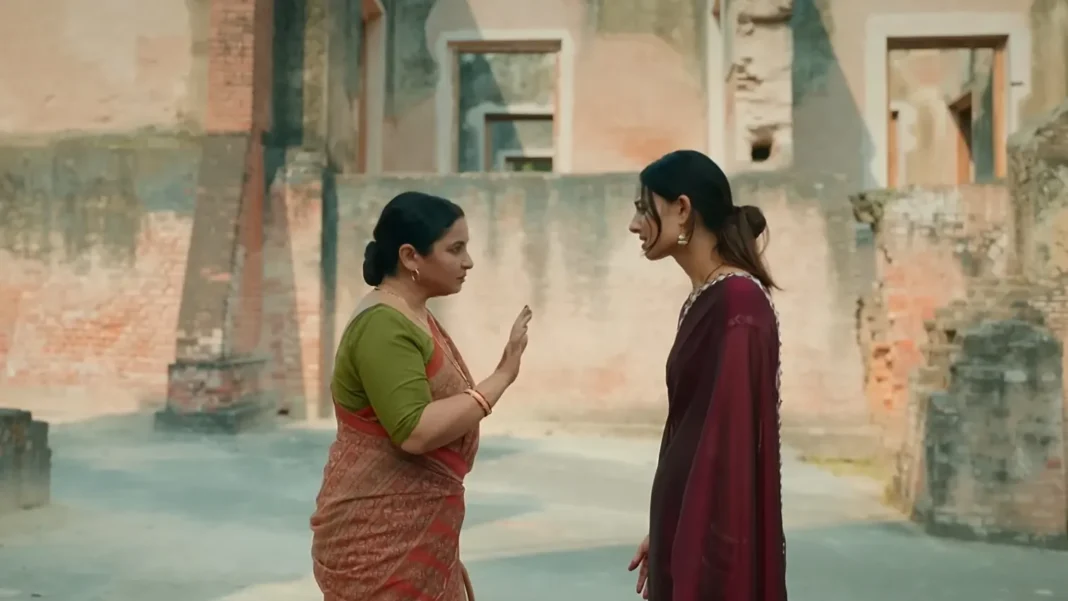
The six-episode Hindi series is based on an idea by Soumyabrata Rakshit, created by Divy Nidhi Sharma, and directed by Shashant Shah. Set in Lucknow, it follows Kamlesh (Divya Dutta), the model daughter-in-law in a close-knit family led by the scholarly Papaji (Sanjay Mishra).
Kamlesh takes pride in tradition, in knowing her place, and in making sure others do too. She dotes on her younger brother-in-law Arun (Siddharth Shaw) almost like a son and shares a loving marriage with her husband Vinay (Faisal Rashid). This reinforces her belief that the family system works perfectly. She does not notice that overindulging Arun partly compensates for her disappointment at having a daughter instead of a son.
Conflict Enters: Pooja’s Struggle
Things begin to shift when Arun’s new bride, the “woke” Pooja (Prasanna Bisht), joins the household. She faces sexual coercion within her marriage, but her resistance is dismissed as immaturity or stubbornness. Kamlesh initially reinforces this system, urging Pooja to adjust, maintain family harmony, and protect their reputation.
The first episodes highlight how entrenched these beliefs are. Kamlesh assumes women belong on the “back pages” reading recipes while men handle important matters. Older women maintain silence, and Pooja’s pushback creates tension. This also forces Kamlesh to confront harsh truths and examine generational inequalities.
Strengths and Touches
Chiraiya handles some aspects effectively. Arun’s casual entitlement feels real, and Pooja’s gradual isolation and manipulation are well-depicted. A legal subplot involving Nanaji (Tinnu Anand) highlights the lack of marital rape laws in India and the need for workarounds.
The show occasionally uses a non-linear structure to explore Kamlesh’s past: her early days as a bride, respect for her father-in-law, curiosity to learn, and belief in a woman’s duties within the family.
Weaknesses: Soap-Trope Tendencies
The series often drifts into soap opera territory. Gender lines remain rigid, and the main emotional arc revolves almost entirely around Kamlesh. The climax feels staged and overly dramatic rather than earned.
Character development is uneven. Kamlesh’s transformation, the emotional backbone, happens too quickly. Vinay, the supportive husband, gets little screen time, and Arun feels like a sketch rather than a complex character. Pooja’s arc also falls short, with little explanation for her agreeing to an arranged marriage or space to exist beyond her trauma. Scenes like her attending an LGBTQ rally feel tokenistic.
Performances
Despite writing flaws, the ensemble shines. Divya Dutta carries the series, giving depth even when the script falters. Sanjay Mishra brings calm authority as Papaji. Prasanna Bisht and Siddharth Shaw are effective as the young couple, while Faisal Rashid adds nuance to Vinay.
Messaging vs. Storytelling
The finale cites statistics from the 2019–21 National Family Health Survey on domestic and sexual violence. It urges families and communities to change mindsets and raise children as equals in the absence of clear marital rape laws.
Chiraiya delivers a crucial message, but its heavy-handedness makes it feel more like a lesson than a story. The show highlights an issue that matters, but it sacrifices narrative subtlety for the sake of its message.